Search engine optimization · Reference
Cluster authority SEO, explained
What it is, the four mechanisms that actually make it work, how it differs from the keyword-by-keyword approach most people mean by “SEO”, and the situations where it is the wrong choice.
What cluster authority SEO is
Cluster authority SEO is a content strategy in which a single pillar page covering an entire topic is published alongside a fixed set of supporting articles, each targeting exactly one sub-query, with all of them linked to the pillar and to each other. The unit of work is the topic, not the keyword.
The intent is that a search engine reads the site as a comprehensive source on that topic, rather than as a pile of unrelated pages that each happen to mention it.
That is the whole idea. Everything below is either the mechanics of doing it or the reasoning for why it produces different results from writing one blog post per keyword.
The underlying architecture is not new and is not proprietary to anyone. It is usually called a topic cluster or a pillar-cluster model, and it entered mainstream marketing vocabulary around 2017, when HubSpot published its version of it.8 “Cluster authority” describes the same structure treated as a complete, finite build — a mapped set of queries, a fixed article count, a publishing order, and a structured data layer — rather than as an open-ended content programme that runs until someone loses interest.
The distinction matters less than the practitioners arguing about it would like. If someone describes a pillar page with supporting articles pointing at it, they are describing this. What follows applies regardless of the label.
The architecture
A cluster has three parts, and the third is the one people skip.
1. The pillar
One page that covers the whole topic at a moderate depth. It is deliberately broad rather than deep. Its job is to be the page a search engine associates with the topic in general, and to be the destination that every other article in the cluster points to. It is normally the first thing published, because everything else links to it.
2. The supporting articles
Each one takes a single sub-question and answers it properly — far deeper than the pillar does. One article, one target query. That constraint is not stylistic. It is what prevents two of your own pages from competing for the same search, which is a genuine and common way that content programmes quietly cap themselves.
3. The links between them
Three link types, all of which have to exist:
- Supporting → pillar. Every supporting article links up to the pillar. This is what concentrates signal on the page you most want to rank for the broad term.
- Pillar → supporting. The pillar links down to each supporting article. This is what stops any of them becoming an orphan page that nothing on the site points to.
- Supporting → supporting. Articles within the same silo link sideways to each other where it genuinely helps a reader. This is the part that gets skipped, and it is a large share of the effect.

A silo is simply a sub-group inside the cluster. On a commercial roofing topic, one silo might cover materials, another cost, another maintenance. Silos exist so that sideways linking has a rule: link freely within your silo, link across silos only when a reader genuinely needs it. Without that rule, “link the articles to each other” degenerates into linking everything to everything, which tells a search engine nothing about structure.
How a topic becomes a cluster
The map is drawn in full before a word is written. This is the least glamorous part of the method and the part that determines whether the rest of it works.
The process is: take the topic, break it into three or four silos, break each silo into the specific questions people actually search, then assign exactly one question to each article. The output is a spreadsheet, not prose — article number, silo, target query, intent, and slug.

Publish for long enough without a map and you will write two articles chasing the same search. Google then has to pick one. It splits the signal between them, often surfaces whichever you would not have chosen, and both rank worse than a single consolidated page would have. This is called keyword cannibalisation, and on established blogs it is frequently the single largest unforced loss in the whole account. Mapping first is how you avoid spending a year building it.
Why it works: four mechanisms
“Topical authority” gets used as though it were an explanation. It is not — it is a label for an outcome. There are four separate mechanisms underneath it, they operate independently, and it is worth being able to tell them apart, because different ones matter more in different markets.
It matches the actual shape of search demand
A topic is not a keyword. It is a distribution: a handful of high-volume terms that everyone competes for, then a much longer tail of specific questions that individually get very little traffic and collectively get a great deal of it. The tail also tends to convert better, because someone typing a precise question has already worked out what they want.
One article cannot rank for a thousand distinct questions, because it cannot be genuinely the best answer to a thousand distinct questions. Twenty can cover a meaningful share of them. The cluster is not a trick to win the head term — it is a structure whose shape matches the shape of the demand.

Internal links concentrate the authority you already have
Links between pages carry ranking signal. That is the original insight behind Google's ranking system, set out in Page and Brin's 1998 paper,4 and Google's own current documentation is explicit that it finds and weighs pages through crawlable links.2 Internal links are links. They are also the only links on the web you control completely.
In a cluster, that control is used deliberately. Every supporting article points at the pillar, so authority pools there. The pillar points back out, so nothing is stranded. And because the articles are interlinked, a link earned by any one of them from outside — a press mention, a supplier's resource page, someone quoting a single statistic — is distributed across the whole structure instead of dead-ending on one page.
This is the mechanism that produces the compounding people describe. It is not mystical. It is that the twentieth article makes the first nineteen measurably stronger, because it adds another node passing signal into them.

Consistent coverage resolves what the site is about
Modern search does not match strings. Since BERT5 and the systems that followed it, queries and documents are interpreted as meaning, which is why a page can rank for a phrase it never contains. Retrieval systems represent both in a way that lets closeness in meaning be measured directly.7
A site covering one topic across twenty articles, using consistent terminology, naming the same entities the same way each time, and linking them together, is an unusually unambiguous signal about what that site is. A site with one article on that topic and forty on unrelated ones is a much noisier one. Nothing here requires a search engine to make a judgement about authority — disambiguation alone does useful work.
This is also why sloppiness in naming costs more inside a cluster than outside one. Calling the same thing three different names across twenty articles throws away most of the signal you were building.
It produces more surface area for AI answer engines to retrieve
Answer engines — AI Overviews, ChatGPT search, Perplexity — generally work by retrieving relevant passages from an index and generating an answer grounded in what came back, the pattern described in the retrieval-augmented generation literature.6 The citation follows the retrieval. Whatever passages were used determine which sources get named.
The consequence is that the unit of competition is the passage, not the website. A site with one article on a topic offers one candidate passage. A site with a full cluster offers many, spread across the specific phrasings real questions take, all using the same vocabulary and corroborating each other.
No commercial answer engine publishes its retrieval and citation logic, and these systems change without notice. That an architecture producing broad, consistent, well-structured passage coverage is favourably positioned for passage retrieval is a reasonable inference from how the systems are built. It is not a measured result, and anyone presenting it as one is overstating what is known.

How it differs from traditional SEO
“Traditional SEO” here means the keyword-led approach: pick target keywords, build or optimise one page per keyword, acquire links to those pages, repeat. It is not wrong and it is not obsolete. It is a different unit of work, and the difference propagates through everything else.

| Traditional keyword SEO | Cluster authority | |
|---|---|---|
| Unit of work | One keyword | One topic |
| Planning | Rolling — next month's keywords chosen next month | Whole query map fixed before writing begins |
| How pages relate | Usually not at all; links added ad hoc | Defined link pattern is part of the specification |
| What success looks like early | A target keyword moves up | Impressions appear across many new queries, before positions move |
| Effect of adding a page | Independent — adds one more chance to rank | Cumulative — strengthens every page already published |
| Main failure mode | Two of your pages end up competing for one query | Build abandoned before the structure is complete |
| Time to first result | Faster on any single term | Slower to start, then steeper |
| Behaviour after an update | Individual pages can drop hard and alone | Broad coverage tends to move less sharply, though nothing is immune |
| Best suited to | Few high-value terms, urgent needs, thin topics | Topics with real question depth and a long horizon |
The most practical difference is in how you read the first three months. On a keyword-led programme, no movement on target terms after three months is bad news. On a cluster build, it is the expected state, and judging it by head-term position that early will make a healthy build look like a failing one. The signal to watch instead is the count of distinct queries the site is receiving impressions for — that expands long before positions do.
What a build actually looks like
Stripped of any particular provider's packaging, the work is:
- Map the topic. Silos, then queries, then one query per article. Finish this before writing.
- Audit what already exists. On any site with history, some of the map is already written — sometimes twice. Consolidate overlaps, redirect duplicates, mark what can be rewritten rather than replaced.
- Publish the pillar. First, because everything links to it.
- Publish supporting articles on a steady cadence. A few a week is typical. The cadence matters mostly because it is sustainable; there is no evidence a search engine rewards a particular rhythm for its own sake.
- Link as you go. Each new article links up to the pillar, sideways within its silo, and gets a link back from the pillar. Retrofitting links across forty articles at the end is miserable and usually done badly.
- Mark it up. Structured data does not make a page rank, and Google says so plainly. It makes a page's content and relationships machine-readable, which affects how it can be presented and understood.3
- Measure the leading indicators. Distinct query count, pages receiving impressions, long-tail average position. Head terms last.
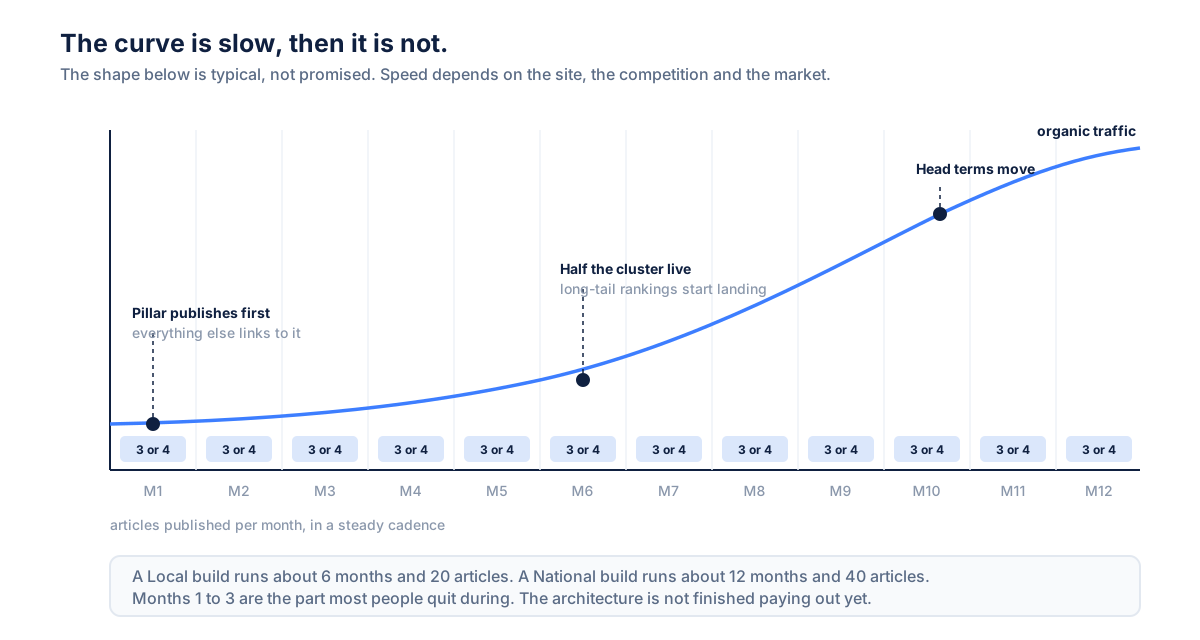
You will see twenty and forty quoted as though they were derived constants. They are not. They are sensible defaults — roughly the number of articles needed to cover a local service topic and a national one respectively without padding. The real number is however many distinct questions your topic contains that are worth a page. For some topics that is twelve. Treat a fixed count as a planning convenience, not a rule of nature.
What the evidence supports, and what it doesn't
This section exists because the topic attracts a lot of confident claims. It is worth separating the parts that rest on documented behaviour from the parts that are inference.
Well supported
- Internal links affect discovery and ranking. Google documents that it finds pages through crawlable links and that links are used in ranking.2 Link-based ranking is the foundation the system was built on.4
- Comprehensive, genuinely useful coverage is what Google says it is trying to reward. Its guidance on helpful content is written almost entirely in terms of depth, first-hand expertise, and whether a page satisfies someone's actual question.1
- Search is semantic, not lexical. Language-model-based query understanding has been in production in Google Search since 2019.5
- Self-competition is real and costly. Two pages targeting one query is a well-documented, routinely measurable problem.
Reasonable inference, not measured fact
- That clusters are preferentially cited by AI answer engines. Consistent with how retrieval-grounded generation works,6 and with the observation that broader passage coverage gives more chances to be retrieved. Not something anyone outside those companies has measured directly.
- That clusters are more resilient to algorithm updates. Plausible, in that a site with coverage across many queries has less concentrated exposure than a site with one page carrying everything. But “resilient” is not “immune”, and broad updates have demonstrably hit sites with deep topical coverage.
Claims to treat sceptically
- Any specific multiplier. “Clusters produce 3× the traffic” and similar figures are almost always drawn from a single vendor's case studies with no control. The mechanism is sound; the number is marketing.
- That a fixed article count is the threshold. Comprehensiveness is relative to competitors, not absolute.
- That structure substitutes for quality. Forty mediocre articles arranged correctly are still forty mediocre articles. The architecture is a multiplier on what you put in it, which means it multiplies weak content too.
Where it does not work
The approach has a well-defined set of conditions under which it is the wrong choice.
| Situation | Why the cluster underperforms |
|---|---|
| You need leads within 60 days | The curve is back-loaded by design. Paid search does this job; content does not. Running a cluster as an emergency measure is how builds get abandoned at month three, which is the most expensive possible outcome. |
| The topic has no question depth | Some topics genuinely have six things worth saying. Forcing twenty articles out of them produces padding, and padding is precisely what Google's helpful-content guidance targets.1 |
| Demand is purely transactional | If nearly every search in the market is someone ready to buy, informational depth has little to attach to. Merchandising, reviews and conversion work matter more. |
| The domain has no authority and no link plan | Internal linking redistributes authority; it does not manufacture it. On a new domain a cluster will pick up thin long-tail terms and stall on anything contested until external links arrive. |
| The site has unresolved technical problems | Pages that are not crawled, not indexed, or too slow to be usable will not rank regardless of how they are organised. Fix the foundations first.9 |
| Nobody can sustain the cadence | A half-built cluster is just some blog posts. If the realistic output is two articles a quarter, plan a smaller cluster rather than an unfinished large one. |
Months one to three look identical whether the build is working or not. That is when the approach gets abandoned, and abandoning it at month three costs the full price of the work with almost none of the return. If a twelve-month horizon is not realistic, the honest answer is to do something else rather than to start this and stop.
Local and national clusters
The architecture is identical. What changes is what makes an article credible and what sits alongside it.
Local
A local cluster targets one city or service area. Articles carry genuine local specificity — neighbourhoods, climate, regional regulation, the local utility or permitting authority — because a page that is a national article with a city name pasted into it reads as exactly that, to readers and to search engines. A local cluster also sits alongside work that is not content at all: the Google Business Profile, citations, and reviews usually determine map-pack visibility more than articles do. Local builds are smaller, commonly around twenty articles over roughly six months, because a single service area contains fewer distinct questions worth a page.
National
A national cluster drops geography, which removes the easiest source of differentiation. What replaces it is substance: original data, named standards or regulations, concrete methodology, real cases. Competition is against publishers who have covered the topic for years, so the required depth per article is higher and the build is larger — commonly around forty articles over roughly twelve months. Head terms take substantially longer to move.
In a local cluster, the thing that makes an article hard to copy is that it is specific to a place. In a national cluster, it has to be that the article knows something. If neither is true, the article is filler, and filler in a cluster is worse than no article — it dilutes the coverage signal the structure is built to produce.
Glossary
- Pillar page
- The broad page covering the whole topic, which every other article in the cluster links to.
- Supporting article
- A page covering one sub-question in depth, targeting exactly one query.
- Silo
- A group of supporting articles covering one sub-area of the topic. Defines where sideways linking is appropriate.
- Topical authority
- A description of the outcome — a site being treated as a strong source on a subject. Not a metric any search engine publishes, and not a thing you can set.
- Keyword cannibalisation
- Two or more of your own pages targeting the same query, causing a search engine to split signal between them. The main failure the query map prevents.
- Internal link equity
- Informal term for the ranking signal passed between pages on the same site through links.
- Orphan page
- A page no other page on the site links to. Hard to discover, and it receives no internal signal.
- Long tail
- The large number of low-volume, highly specific queries within a topic. Individually small, collectively the larger share, and usually higher intent.
- Structured data
- Machine-readable markup, normally JSON-LD using schema.org vocabulary, describing what a page is and how it relates to other things. Affects understanding and presentation, not ranking directly.
- Passage retrieval
- Selecting individual passages rather than whole documents as the candidates for answering a query. The mechanism that makes paragraph-level coverage matter.
- Query map
- The document assigning one target query to each planned article before writing starts.
Common questions
Is cluster authority SEO the same thing as a topic cluster?
They describe the same underlying architecture. “Topic cluster” is the general term, popularised by HubSpot around 2017.8 “Cluster authority” is that structure treated as a complete, fixed-size build with a mapped query set, a publishing order and a structured data layer, rather than an open-ended content programme. If someone describes a pillar page with supporting articles linking to it, they are describing the same thing.
How many articles does a cluster need before it starts working?
There is no threshold number that switches results on, because it depends entirely on how thoroughly competitors have already covered the topic. The usual pattern is that individual long-tail articles pick up impressions within weeks of being indexed, while movement on competitive head terms follows only once a substantial share of the cluster is live and interlinked. Comprehensiveness is relative, not absolute.
Does the pillar article have to publish first?
Strongly preferable. Every supporting article links to the pillar, so if it does not exist yet, either those links are missing or you revisit the articles later to add them. Publishing it first also gives the page that will accumulate the most internal links the longest time in the index. Not a technical requirement, but publishing out of order creates avoidable rework.
What happens if you stop a cluster halfway through?
You keep what the published articles earned individually and lose the compounding. A half-finished cluster is a set of articles covering part of a topic — roughly what ordinary content marketing produces. Nothing is destroyed. But the case for the approach is that later articles strengthen earlier ones, and that is the part that does not happen.
Do all the articles have to be on the same domain?
Yes, if the goal is topical authority for that domain. The mechanism depends on internal links between the articles and on a search engine associating the whole body of coverage with one site. Splitting a cluster across domains breaks both. Off-site placements can support a cluster; they are not part of it.
How is this different from just publishing a lot of content?
Volume without a map produces overlap. Publish long enough and you will write two articles targeting the same search, at which point the signal splits and both do worse than one would have. A cluster is defined by the constraint rather than the volume: one target query per article, a map drawn before writing, and a deliberate linking pattern. Twenty mapped articles will usually beat sixty unmapped ones on the same topic.
Does a cluster work on a brand-new domain with no backlinks?
More slowly, with a lower ceiling on competitive terms. Internal linking redistributes authority; it does not create it. On a new domain there is little to redistribute, so the cluster picks up long-tail queries where competition is thin while head terms stay out of reach until the domain earns external links. The architecture makes the links you have count for more — it is not a substitute for having them.
How do you tell whether it is working before rankings move?
Leading indicators show up in Google Search Console well before positions change. The useful ones are the number of distinct queries generating impressions, the number of pages receiving any impressions, and average position on long-tail queries specifically. Query count expanding while positions are still poor is the normal early signal. Watching only head terms in the first months will make a working build look like a failing one.
Can a cluster be retrofitted onto an existing blog?
Usually, and it is often cheaper than starting fresh. The work is an audit: map existing posts against the intended query set, consolidate or redirect overlaps, rewrite posts that are close to a target query but thin, identify the remaining gaps, then apply the linking pattern across all of it. Resolving existing cannibalisation frequently produces movement on its own, before any new article is published.
Does AI-written content work inside a cluster?
Google's stated position is that it assesses quality regardless of how content was produced, and that the problem is content made primarily to manipulate rankings rather than the tool used to write it.1 The specific failure mode inside a cluster is worth knowing: forty articles generated from similar prompts tend to repeat the same points in the same structure, which undercuts exactly the comprehensiveness the architecture is meant to demonstrate. The structure amplifies what you put in it, in both directions.
Sources and further reading
Primary documentation and research underlying the claims above. Where this page marks something as inference rather than fact, no source is cited, because none exists.
- Creating helpful, reliable, people-first content — Google's own statement of what it is trying to reward, including its position on automatically generated content. Google Search Central documentation
- Make your links crawlable — how Google discovers pages through links, and why link structure determines what gets found. Google Search Central documentation
- Introduction to structured data markup — what schema.org markup does and, importantly, what it does not do. Google Search Central documentation
- The Anatomy of a Large-Scale Hypertextual Web Search Engine — Brin and Page, 1998. The original description of link-based ranking. Stanford InfoLab
- Understanding searches better than ever before — Google's announcement of BERT in Search, 2019; the shift from matching words to interpreting meaning. See also the original BERT paper. The Keyword, Google
- Retrieval-Augmented Generation for Knowledge-Intensive NLP Tasks — Lewis et al., 2020. The pattern behind grounded, source-citing AI answers. arXiv
- Introduction to Information Retrieval — Manning, Raghavan and Schütze. The standard textbook; the chapters on ranked retrieval and the vector space model cover the fundamentals. Cambridge University Press, free online edition
- Topic clusters: the next evolution of SEO — the article that put the pillar-and-cluster model into mainstream marketing vocabulary. HubSpot
- Google Search Essentials — the technical baseline a page has to meet before any of this matters. See also Core Web Vitals. Google Search Central documentation
- Search Quality Rater Guidelines (PDF) — the instructions Google gives human raters, and the clearest available description of how it defines expertise, experience, authoritativeness and trust. Google
- Google Search's AI features and your website — Google's own guidance on how sites appear in AI Overviews and AI Mode. Google Search Central documentation
- schema.org vocabulary — the shared vocabulary used for the structured data on this page. schema.org
About this page
Written by Mark Blum, who has been building content clusters for businesses and for other agencies since founding SEO249 in 2017. The agency builds this kind of thing for a living, which is a conflict of interest worth stating plainly — it is also why the sections on what the evidence does not support and where the approach fails are on the page.
Nothing here is for sale. If you want the version with pricing attached, that lives at seo249.com. If you found an error, or you have measured something that contradicts what is above, mark@seo249.com.
Last reviewed . This page is updated when the underlying search behaviour changes, not on a schedule.